
American Airlines Rejects United Merger: Why the Mega-Deal Crashed Before Takeoff
Picture this: the CEO of United Airlines walks into the White House and casually suggests merging with American Airlines. The room goes quiet. President Trump raises an eyebrow. And just like that, the biggest airline merger idea in history takes flight—only to get shot down four days later by American's board with a blunt "thanks, but no thanks." Welcome to the wildest week in aviation since someone invented the middle seat.
Quick Navigation
What Actually Happened? The Timeline
On February 25, 2026, United Airlines CEO Scott Kirby sat down with President Donald Trump and senior federal officials at the White House. The meeting's official purpose? Discussing the future of Washington Dulles International Airport. Kirby's unofficial pitch? Let's merge United and American into one airline behemoth [^41^].
The news didn't break publicly until April 14, when Bloomberg reported Kirby's proposal. Markets reacted instantly. American's stock jumped 5% in premarket trading. United shares rose roughly 2%. Investors love consolidation because fewer competitors usually mean fatter margins [^39^].
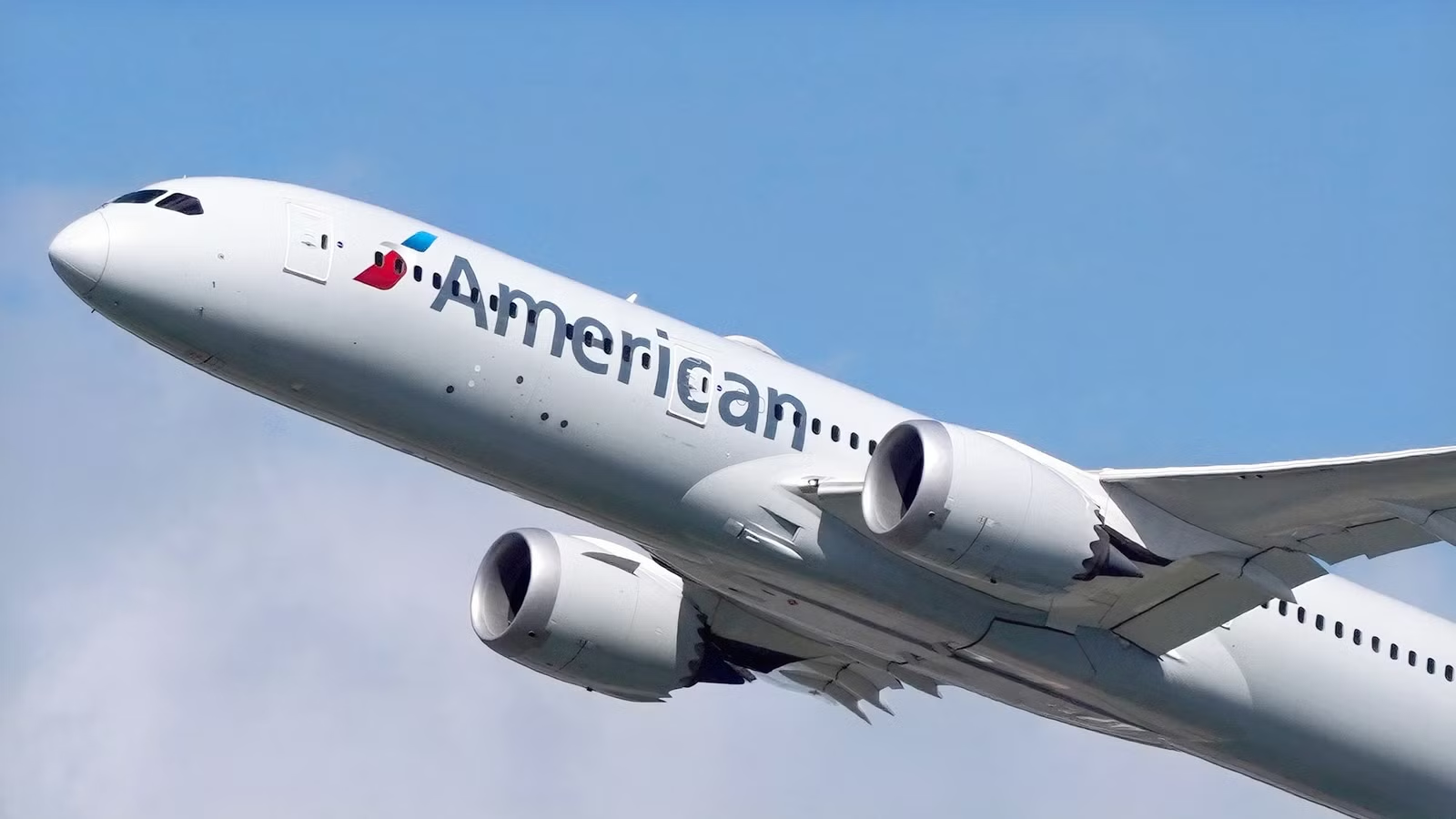
Then came the plot twist. On April 18, 2026—just four days after the story broke—American Airlines issued a statement so direct it could have come from a flight attendant announcing a delay: "American Airlines is not engaged with or interested in any discussions regarding a merger with United Airlines" [^48^].
Kirby argued that a merged carrier would better compete internationally, where foreign airlines dominate long-haul routes despite U.S. citizens making up most passengers [^39^]. He also pointed to rising fuel costs—jet fuel spiked to $4.88 per gallon in early April—as a catalyst for industry restructuring [^40^].
American wasn't buying it. Their statement added: "While changes in the broader airline marketplace may be appropriate for others, American is focused on executing its own strategy" [^50^]. Translation: we're busy fixing our own mess. Leave us alone.

The Antitrust Nightmare: Why Regulators Would Have Said No
Even if American had said yes, this deal faced regulatory headwinds that make a Chicago winter look mild. Antitrust experts practically lined up to explain why the government would block this marriage.
William Kovacic, director of the competition law center at George Washington University, didn't mince words: "This seems hopeless to me. There are huge overlaps on a number of routes and in various metropolitan areas (such as Chicago). No amount of divestitures would fix it" [^39^].
Here's the math that matters. The U.S. airline market already concentrates 80% of domestic capacity among four carriers: American, Delta, Southwest, and United [^41^]. Combining two of them would shrink the "Big Four" to a "Big Three," with one airline controlling roughly 33% of the market [^40^].
| Airline | 2025 Domestic Market Share | Annual Revenue (2025) | Fleet Size |
|---|---|---|---|
| Delta Air Lines | ~20% | $63.4 billion | 1,314 |
| United Airlines | ~20% | $57.1 billion | 1,014 |
| American Airlines | ~20% | $56.9 billion | 1,860 |
| Southwest Airlines | ~20% | $25.1 billion | 803 |
| Combined United-American | ~40% | $114 billion | 2,874 |
The historical precedent isn't encouraging either. In 2013, the Department of Justice sued to block American's merger with US Airways, arguing it would "substantially lessen competition" and force passengers to pay higher fares [^45^]. That deal eventually closed after American agreed to divest slots at key airports, but it was a much smaller combination than United-American would be.
Transportation Secretary Sean Duffy did signal openness to consolidation on CNBC, noting that Trump "loves to see big deals happen" [^41^]. But Duffy added a critical caveat: larger airlines would need to "peel off some of their assets" [^41^]. For United and American, that might mean surrendering so many gates and routes that the merger loses its strategic value.
What a Combined Airline Would Look Like
Let's play fantasy airline for a moment. If United and American had merged, what would travelers actually experience?
On paper, the network looks compelling. United dominates the Midwest and West Coast hubs (Chicago O'Hare, Denver, San Francisco, Los Angeles). American controls Dallas-Fort Worth, Charlotte, Miami, and Philadelphia. Together, they'd blanket the country with only minimal geographic overlap [^43^].
But the devil lives in the details. Both carriers operate massive hubs at Chicago O'Hare. Both fight fiercely for corporate contracts in New York. Both have extensive transatlantic networks that would trigger European antitrust scrutiny. The DOJ's 2013 complaint against the American-US Airways merger noted that combining networks often eliminates "Advantage Fares"—discount connecting flights that undercut nonstop pricing by up to 40% [^45^].
Labor unions also prepared for battle. The Allied Pilots Association, representing American's 15,000+ pilots, immediately opposed the idea. Combining seniority lists between two massive workforces creates conflicts that can take years to resolve—just ask anyone who lived through the United-Continental merger integration.
American's Rejection: The Official Word
American Airlines didn't just reject United's overture—they slammed the door, locked it, and posted a "Do Not Disturb" sign. Their April 18 statement left zero ambiguity.
"American Airlines is not engaged with or interested in any discussions regarding a merger with United Airlines," the company said [^48^]. The New York Times reported the same day that American viewed changes in the broader marketplace as appropriate "for others," but not for themselves [^50^].
This rejection makes strategic sense when you examine American's recent struggles. The carrier has fallen behind Delta and United in profitability and premium revenue. CEO Robert Isom has focused on fixing operational reliability and closing the revenue gap—not on digesting the industry's largest merger [^39^].
Wall Street initially punished American's stock for the rejection, but industry analysts largely supported the decision. As one Dallas Morning News columnist noted, a tie-up between two of the industry's biggest brands would be "challenging... but not totally impossible" [^51^]. American apparently decided "challenging" wasn't worth the headache.
The Bigger Picture: Why Merger Talk Is Back
United's proposal didn't emerge from nowhere. The airline industry faces a perfect storm of financial pressure that historically triggers consolidation.
Jet fuel prices have surged 66% since the U.S.-Israeli conflict with Iran began in late February 2026 [^40^]. Delta expects more than $2 billion in incremental fuel costs through June alone, prompting fare hikes and capacity cuts [^40^]. When oil prices spike, airlines merge. It's practically a law of physics.
Delta CEO Ed Bastian acknowledged this pattern directly. "I anticipate higher fuel prices will cause much more significant structural reform than we've seen over this period," he said, citing the 2008-2014 merger wave that created the current "Big Four" structure [^41^].
The Trump administration has also signaled a softer antitrust stance. The DOJ ended its review of Allegiant's takeover of Sun Country in March 2026 with no objections—a sharp contrast to the Biden administration, which blocked JetBlue's acquisition of Spirit in 2024 [^41^].
Other deals remain in play. JetBlue has reportedly hired advisers to explore mergers with Alaska, Southwest, or United [^41^]. Frontier and Spirit continue their years-long dance. Alaska is still integrating Hawaiian Airlines after closing that deal in 2024 [^41^].
But the United-American proposal was always the longest of long shots. As The Points Guy noted, "the most obvious combinations are not always the ones that occur" [^41^]. Sometimes the obvious combination is also the obviously illegal one.
What This Means for Your Wallet and Your Flights
For everyday travelers, American's rejection is probably good news. Here's why.
Competition keeps fares in check. The DOJ's 2013 lawsuit against American-US Airways explicitly stated that consolidation "would result in passengers paying higher airfares and receiving less service" [^45^]. When US Airways executives bragged that "three successful fare increases" happened because of consolidation, the DOJ quoted them in its complaint [^45^].
A United-American merger would have created a loyalty program so large it would reshape credit card markets. United's MileagePlus partners with Chase; American's AAdvantage works with Citi and Barclays. Combining them would force a renegotiation of co-brand deals worth billions annually [^40^].
However, American's standalone strategy carries its own risks. The carrier must close the profitability gap with Delta and United while fending off low-cost competition. If American stumbles, another suitor—perhaps foreign-owned through creative structuring—could emerge.
The bottom line? Your summer vacation plans remain safe from mega-merger disruption. But keep watching those fuel surcharges. Airlines pass along every penny of oil price spikes, merger or no merger.
Frequently Asked Questions
United CEO Scott Kirby floated the idea to President Trump and senior officials on February 25, 2026. No formal proposal or merger agreement was ever filed. American rejected even informal discussions on April 18, 2026 [^41^][^48^].
American stated it remains focused on executing its own standalone strategy. The carrier has struggled to match Delta and United's profitability and likely viewed a massive merger as a dangerous distraction from operational improvements [^50^][^39^].
Most antitrust experts say no. The combined airline would control roughly 40% of the U.S. market, creating a "Big Three" structure with massive route overlaps, particularly in Chicago and New York [^39^][^40^].
United's MileagePlus (Chase) and American's AAdvantage (Citi/Barclays) would require massive restructuring. The combined loyalty data platform would be the largest in U.S. travel, forcing credit card partnerships back to the negotiating table [^40^].
Yes. JetBlue is reportedly exploring deals with Alaska, Southwest, or United. Frontier and Spirit continue merger discussions. The Trump administration has signaled openness to consolidation among smaller carriers [^41^].
High jet fuel prices historically trigger consolidation as airlines seek cost synergies. Prices surged 66% following the Iran conflict, with Delta projecting $2 billion in added costs through June 2026 [^40^][^41^].
Related Reading
For more analysis on corporate strategy and market dynamics, explore our coverage of business psychology and decision-making frameworks over at MindUnplug. Understanding why companies reject seemingly logical deals helps explain the human factors behind boardroom decisions.
Book early, compare fares across all four major carriers, and watch for fuel surcharge adjustments. The merger may be dead, but airline pricing remains as unpredictable as ever.
Last Updated: April 18, 2026
Sources: Wall Street Journal | New York Times | USA Today | The Points Guy | eMarketer | U.S. Department of Justice


