
Tornado Watch: Your Complete Safety Playbook (2025)
A tornado watch doesn't mean panic—it means prepare. Here's everything you need to know about staying safe when conditions turn dangerous, straight from NOAA experts.
What Is a Tornado Watch? (The "Heads Up" Alert)
Imagine you're planning a barbecue. The forecast says conditions are perfect for rain—humid air, dark clouds forming, that heavy feeling in the atmosphere. You don't cancel the party yet, but you keep an eye on the sky. That's exactly what a tornado watch is: Mother Nature's way of saying, "Hey, the ingredients for trouble are mixing."
According to NOAA's Storm Prediction Center (SPC), a tornado watch is issued when atmospheric conditions are favorable for tornado development [^1^]. This includes strong thunderstorms with rotation potential, wind shear, and instability in the atmosphere. The watch typically covers large areas—sometimes multiple states—and lasts between 4 to 8 hours [^6^].
🎯 Key Takeaway
A tornado watch means tornadoes are possible, not that they're happening. It's your window to prepare before a warning might force you to take immediate shelter.
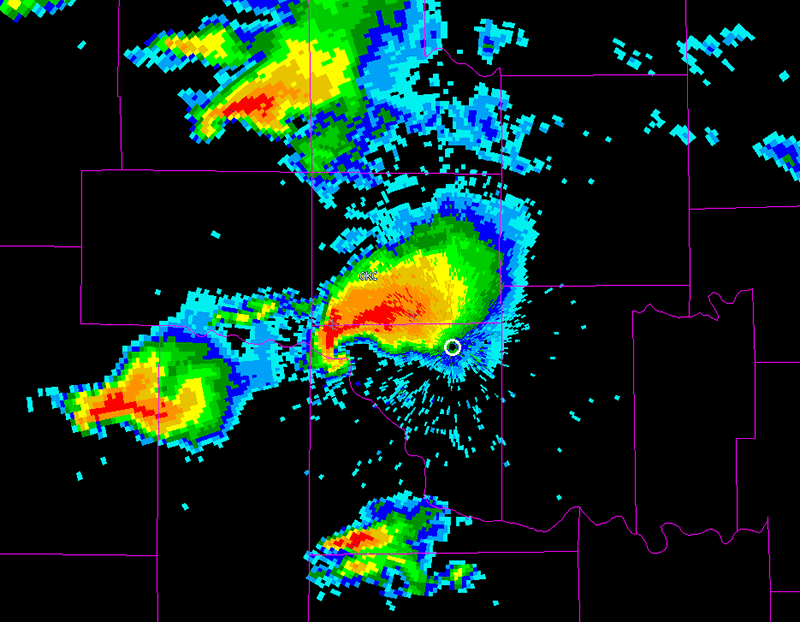
Tornado Watch vs. Warning: Don't Mix These Up
Here's where people get confused—and confusion during severe weather can be dangerous. Let's clear this up with a simple analogy that the Normal, Illinois Fire Department made famous: the taco method [^1^].
🌮 Taco Watch
Translation: We have all the ingredients for tacos.
Weather Version: A tornado watch means conditions are right for tornadoes, but none have formed yet.
- Issued by: Storm Prediction Center (Norman, Oklahoma)
- Coverage: Multiple counties or states
- Duration: 4-8 hours
- Your action: Review plans, stay alert
🚨 Taco Warning
Translation: Tacos are happening RIGHT NOW.
Weather Version: A tornado warning means a tornado is spotted or radar-indicated—take shelter immediately.
- Issued by: Local National Weather Service office
- Coverage: Specific counties or city areas
- Duration: 20-60 minutes
- Your action: Seek shelter immediately
The SPC issues approximately 1,000 tornado and severe thunderstorm watches annually across the U.S. [^1^]. When a watch is issued, local National Weather Service offices adjust the boundaries by adding or removing specific counties before alerting the public [^6^].
Your Tornado Watch Action Plan
So your phone just buzzed: "Tornado Watch issued until 8:00 PM." Now what? This isn't the time to panic—it's the time to prepare. Here's your step-by-step checklist based on official NOAA guidelines [^5^]:
Immediate Steps (First 15 Minutes)
- Gather your people. Locate family members and pets. If a warning follows, you won't have time to search.
- Charge everything. Plug in phones, laptops, and portable chargers. Power outages often accompany severe storms.
- Check your safe space. Identify the lowest, most interior room in your home—preferably a basement or storm cellar. Avoid windows.
- Turn on notifications. Enable emergency alerts on your phone and tune a TV or radio to weather updates.
Next Steps (While You Wait)
- Review your emergency plan with family members
- Check your emergency kit (water, flashlights, batteries, first aid)
- Move outdoor furniture, trash cans, and decorations inside—they become projectiles in high winds
- Fill your car's gas tank in case evacuation becomes necessary
- Wear sturdy shoes (you might need to walk through debris later)

How Tornado Watches Get Issued (The Science Behind the Alert)
Ever wonder who's watching the skies? Meet the Storm Prediction Center in Norman, Oklahoma—a facility that looks like NASA mission control but for weather [^2^]. These meteorologists monitor conditions 24/7 across the entire United States.
Here's how the process works [^6^][^9^]:
Monitoring
SPC meteorologists analyze weather models, satellite data, and atmospheric conditions looking for instability, wind shear, and moisture.
Consultation
Before issuing a watch, SPC contacts local National Weather Service forecast offices to discuss the developing situation.
Issuance
SPC issues a preliminary watch, then local offices adjust county boundaries and release the public alert.
Updates
Status reports issue every few hours. Watches can be extended, expanded, or cancelled early if conditions change.
The SPC uses a three-tiered alert system: Outlook (be aware), Watch (be prepared), and Warning (take action) [^13^]. This hierarchy helps communities prepare without causing unnecessary panic.

Expert Safety Tips That Could Save Your Life
Let's get serious for a moment. Tornadoes kill an average of 78 people annually in the U.S., though that number varies year to year [^10^]. But here's the good news: even violent tornadoes have a survival rate of at least 99% when people follow proper safety protocols [^7^].
If a Warning Is Issued (Act Immediately)
🏠 At Home
Go to the basement or an interior room on the lowest floor. Bathrooms and closets often work well. Stay away from windows, doors, and outside walls. Protect yourself with a mattress or blankets—flying debris causes the most injuries [^7^].
🚗 In a Vehicle
Don't try to outrun it. Drive to the nearest sturdy shelter. If that's impossible, stay in your car with your seatbelt on, head below the windows, and cover your head. Or abandon the car and lie in a low ditch—never hide under an overpass [^5^].
🏢 At Work/School
Follow established drills. Move to interior hallways or designated shelter areas. Avoid large open rooms like cafeterias or auditoriums where roof collapse is more likely [^5^].
🏕️ Outdoors
Find a sturdy building immediately. If none exists, lie flat in a low area and cover your head with your arms. Get as far from trees and vehicles as possible—they can roll onto you [^5^].
⚠️ Debunking a Dangerous Myth
Forget the old advice about opening windows to "equalize pressure." It's useless and wastes precious time. A tornado will blast open windows for you. Focus on getting to shelter instead [^7^].
2024: A Record-Breaking Year for Tornadoes
If you thought tornado season felt intense last year, you weren't imagining it. 2024 was the second-most active tornado year on record since 1950, with 1,796 confirmed tornadoes—just 21 shy of the historic 2004 season [^10^].
Key Statistics from 2024
Six states broke their annual tornado records in 2024 [^10^]:
- Illinois: 142 tornadoes (previous record: 125 in 2006)
- Iowa: 125 tornadoes (previous record: 120 in 2004)
- Oklahoma: 152 tornadoes (previous record: 148 in 2019)
- Ohio: 74 tornadoes (previous record: 61 in 1992)
- New York: 32 tornadoes (previous record: 25 in 1992)
- West Virginia: 20 tornadoes (previous record: 14 in 1998)
Despite the high tornado count, fatalities remained below average—proof that early warnings and public awareness work. Interestingly, 33 of the 54 deaths occurred in manufactured or mobile homes, highlighting the importance of finding sturdy shelter [^10^][^11^].
Monthly Tornado Distribution 2024
Data source: NOAA Storm Prediction Center. Peak season (April-May) accounted for over 50% of annual tornadoes.
Digital Tools for Tornado Preparedness
In our connected world, your smartphone is a powerful safety tool—when used correctly. During a tornado watch, digital preparedness can mean the difference between being caught off-guard and reaching safety in time.
Research from the University of Washington shows that standardized digital tools help communities assess emergency readiness more effectively [^21^]. For tornado preparedness specifically:
- Multiple alert sources: Don't rely on just one app. Use NOAA Weather Radio, local TV, and smartphone alerts simultaneously.
- Offline maps: Download offline maps of your area in case cell towers go down.
- Emergency contacts: Program ICE (In Case of Emergency) contacts and save them to your lock screen.
- Document storage: Keep photos of important documents in cloud storage for post-disaster recovery.
Speaking of digital wellness and preparedness, check out our guide on maintaining digital wellness during stressful events to avoid information overload while staying informed.
Frequently Asked Questions About Tornado Watches
Does a tornado watch guarantee a tornado will form?
No. A watch means conditions are favorable, but many watches expire without any tornadoes touching down. Think of it like a "yellow light"—proceed with caution and be ready to stop if necessary [^2^].
How long do tornado watches typically last?
Most tornado watches last between 4 to 8 hours, though they can be extended if conditions persist or cancelled early if the threat passes [^6^].
Can a tornado warning be issued without a watch first?
Yes. While watches provide advance notice, rapidly developing storms can trigger warnings directly. This is why having multiple alert methods matters [^4^].
What's the safest room in my house during a tornado?
The lowest floor, in the smallest, most interior room possible. Basements are best. If you don't have one, use a bathroom, closet, or hallway on the ground floor. Put as many walls between you and the outside as possible [^5^].
Why are mobile homes particularly dangerous?
Mobile homes are not anchored to foundations and can be flipped or rolled even by weaker tornadoes. In 2024, 61% of tornado fatalities occurred in manufactured housing [^10^][^11^]. If you live in a mobile home, identify the nearest sturdy shelter before a watch is even issued.
Essential Resources & Links
🌐 National Weather Service
Official forecasts, watches, and warnings for your local area.
📊 Storm Prediction Center
Detailed severe weather outlooks and watch information.
🛡️ Ready.gov
FEMA's comprehensive tornado preparedness guide.
❤️ American Red Cross
Emergency supplies checklists and shelter information.


